Saturday, 12 January 2013

January 10, 2013 - Day 4

The night before I slept very well and woke up refreshed and ready to fly. The weather forecast for the day (shown below) was quite good, calling for 1/8 of Cu's and lift up to 2300 meters  in the best areas, with the average lift of 2 to 3 m/s in the afternoon.

However, the actual weather was blue thermals of 1 to 1.5 m/s to 1400 meters in the best areas and much worse than that in the wet zones. Luckily, the wind was more or less as forecast, unlike most other days when it turned out to be much stronger.


Luckily, the task setter Eduardo Toselli chose a cautious approach and set an assigned area task (AAT) that you can see below.
Day 4 task for the Club Class
I was the first on takeoff and managed to get a good thermal right after the release. I climbed to 1100 m and then headed into the wind and towards the 1st TP to check the conditions. There was some lift along the way and my glide ratio was quite good, considering the 25 km/h headwind. However, after turning back I encountered heavy sink and, with no other glider circling in the vicinity, I barely made it back to land on the runway 36. When Luis asked what happened, I told him that I made it back as I had promised I would do that day, just a bit early. Since by that time the last of the Club class gliders were being launched, I soon got back after only 10 minutes on the ground.

As usual for this competition, the day brought a lot of gaggle flying in weak bumpy thermals, but this day I felt good and up to the challenge. The other trick was not getting caught low in the wet areas. Other than that, the whole flight for me was  quite uneventful, except right after the start when I got relatively low at 650 m (450 m above ground), but since several others, including the current Club class world champion Arndt Hovestadt, were much lower, it didn't seem that bad.

The lift was between 0.9 m/s when climbing in a gaggle and 1.5 m/s when alone or in a small group. Therefore the key was to join the big gaggle only when necessary. The other trick was to go a little deeper into the cylinders and then rejoin the gaggle from below where it's less crowded. My flight trace is below.

My flight track from Day 4
What also made a difference was the improved cockpit (and pilot) cooling system that I installed into Kilo-Yankee, with water cooling for cruise (a water spray bottle) and air cooling during climb (a flexible tube to redirect the air from the scoop).

At the end, my effort earned me the second daily win, which this time didn't come as a surprise because I knew that I had done quite well given the conditions.

The one scary  moment came when I realized that my Nano primary logger hadn't recorded the whole flight because the memory card popped out (an old problem that I thought I had fixed). Luckily, my secondary logger had the whole flight recorded.

In the evening the organizers threw an international party with most of the teams preparing some food or beverage offerings. The Brazilians prepared large amounts of kyperinia (the spelling is probably wrong), which is a mix of vodka (or kashasa for the real kyperinia), lime, sugar and crushed ice. It goes down easy, but you have to be careful with it, so I had just one serving. The well financed and well organized Polish team prepared a poster presentation and showed a very interesting documentary film from the 1963 World Gliding Championship held in Junin, Argentina.

Next day at the briefing I got another yellow jersey and a bottle of wine and this time a kilo of local cheese, which of course, I donated to the Brazilian team.

Below are a few photos from Day 4:
Waiting on the grid for take-off

Circling in another gaggle. My newly installed air cooling snorkel is reflected off the canopy.


Back at the airfield after completing the task

Kilo-Yankee cockpit with the air cooling snorkel

International party night


Friday, 11 January 2013

January 9, 2013 - Day 3

First I must apologize for the lack of news until now. Landing out 3 times in the past 4 days didn't leave me much time for doing much else other than what's required for the competition. However, yesterday (Jan 11) I completed the task and I will try to give you the updates.

Day 3 began with very nicely. At the pilot's briefing I was declared as the winner of Day 2 and given a kilo of locally made caramel, which I donated to the Brazilians (since I'm allergic to all dairy), a  bottle of very nice Cabernet Sauvignon (which will wait till my wife Karyn arrives to Buenos Aires) and a yellow jersey, kind of those they give out in the Tour-de-France. A very nice touch by the organizers.
The task winner loot 
The weather forecast was good with mostly blue but strong thermals and even a few Cu's at the sea breeze boundary. We were given a 2:45 assigned area task, with the first TP to the Southwest, the second one to the North and then back East before turning home to Chaves (http://www.soaringspot.com/wgc2012/results/club/task/day3.html).

After we got launched into the blue sky, it was back to gaggle flying in worse-than-forecast conditions (which has become standard so far in this competition). This was going to be the 4th day in a row of more or less constant gaggle flying in bumpy and broken up thermals.

A "gaggle" on Day 3
After a relatively close encounter in one of the gaggles, I decided that I should take a break from gaggle flying for today, as I was starting to feel quite a bit stressed by it. So, I waited till everyone had gone on task, then climbed up and started the task alone, with no other gliders in sight. On a blue day this is risky because you never know where the next thermal will be and if you will manage to find it alone. However, in spite of that, I felt much better and had a very relaxed and enjoyable flight. Unfortunately, as I mentioned earlier, while the lift was weaker than forecast, the wind was stronger (up to 50 km/h at one point) and the day died early, probably because of the strong wind. I almost made it back, but was about 12 km short of the finish.

I landed out in another stubble field next to the road from Chaves to Tres Arroyos. Luis and Leo (part of the Brazilian team) found me without problems and we were back at the airfield at the sunset.
Sunset through the trees at the farm I landed at on Day 3
Points-wise I didn't do very well as most of the Club class pilots finished the task and I dropped from 2nd to 21st in the overall standings. However, I am quite happy with my decision to place safety and my piece of mind above the sporting result. I do this because I love to flying and I want to keep doing it for many years to come.

Wednesday, 9 January 2013

January 8, 2013 - Day 2

Just a brief note for now since I've got to rig the glider this morning. We had a 248 km racing task yesterday in difficult condition with broken up blue thermals and moderate wind. Nobody made it home, although most of us landed within the 20 km of the finish line. I was some 3.5 km short and it appears that the effort was good enough for the 1st place for the day.

Crowded bumpy thermals all day long...

Kilo-Yankee in the stubble field.
Sorry, I forgot to mention that there is on-line real time tracking for a few gliders in each class. I carried the tracking gear on Day 2 and will probably be carrying it on Day 3.

You can use the following links, at least one of them should work.
http://www.wgc2012.com.ar/novedades.php?uno=54

http://bit.ly/115UuxV

Here's an update on Day 2 task and how it unfolded. You can see the flight trace in the picture below.
My flight trace on Day 2
I started the task at 14:55 with a number of other pilots. My progress towards the first turn point was very slow. It took me an hour and 45 minutes to cover 94 km, flying against a 30 km/h head wind with the average climb rate of 1.3 m/s. Constant gaggle flying made things worse, having to be extremely alert in order to avoid any close encounters in the bumpy thermals.

While in cruise the Sun was beating down into my face and the temperature in the cockpit must have been in the 40's. Unfortunately, the ventilation in Kilo-Yankee is very poor due to the tow hook being installed in the nose (normally on a Std. Cirrus it's below the cockpit just ahead of the main wheel), blocking about 80% of the ventilation air flow into the cockpit. The only way to get some air in was to open the little scoop on the canopy window, which do in the thermal, but I usually keep it closed in cruise to minimize the drag.

Probably because of the heat and constant gaggle flying, I noticed that my flying wasn't as smooth and my decision making wasn't as good I usual. Also, for some reason my group managed find only broken up thermals and lost about 15 to 20 minutes compared to the group ahead of us.

About 20 km before the first TP we finally found a relatively good thermal and I managed to climb up to 1750 meters, which was the highest point of the flight. I was the first one to leave the thermal and went straight for the TP. Just before the TP I encountered some sink and after rounding the TP, I saw the rest of my group coming in about 150 meters higher, as they must have avoided the sink. In a way this was helpful because I then took a slight detour south of the course line into the area from which the rest of the group came to the TP. This turned out to be a good decision and I found another 1.7 m/s thermal that took me back up to 1650 meters. To make things better, the rest of the group continued straight on the course to the 2nd TP, so I finally had a luxury of having a good thermal jut to myself!

The second leg of the task proved to be the easiest, thanks to the tail wind, the Sun at my tail and not-too-bad lift. This only lasted for about half an hour, but was a welcome break.

After rounding the 2nd TP, the things got worse, much worse, due to the very wet terrain in that area. All of a sudden, I found myself low and in a big gaggle endlessly moving from one weak bumpy thermal to the next on which would usually be the same or worse. Luckily, we were drifting downwind.

Just before the 3rd TP, as I was circling in a week thermal, I noticed that the wind has suddenly changed direction and became mainly Southerly, meaning that we would have a head wind on the last leg. Some days you just don't get many breaks. Having made a couple of tries outside of the gaggle, I was now among the gliders at the bottom of the gaggle, and this was probably the low point of the task in every regard. Since the wind started pushing us North, away from the TP, the gliders above me started leaving. I decided to stay for a couple of more circles because being alone in the thermal enabled me to improve my rate of climb. After two or three more circles I noticed a group of 4 Ximangos (a small bird of prey) circling at my altitude a few hundred meters North. Of course, I joined them and to my delight found a solid 1 m/s that took me to 900 m. As the Ximangos went South, I followed them and they soon located another 1 m/s thermal that I rode to 1100 m.

From there I passed through the TP sector and set off into the quartering headwind towards Chaves. I decided to veer a little bit to the West (the upwind side). Along the way I managed to find a few more 0.5 to 1 m/s thermals and, to my surprise, I found a lot of lift and reduced sink in cruise. At one point, I made a 10 km glide into the 20 km/h headwind at a 103 glide ratio! I guessed (correctly) that I managed to stumble upon a convergence line that just may be enough to carry me back across the finish line. However, as I turned towards the airfield, the convergence line disappeared and the lift turned into sink. As I called in the "Operaciones" on 123.0 (the official frequency) announcing the 10 km distance to the finish line, I added that I wasn't sure if I was going to make it. Two minutes later, I called again and told them that I was going to lend out, to which Enrique, the director of operations, replied "OK, good luck Branko." I could choose between several stubble fields and I decided to land in the one where I saw that someone had already landed. Being competitive, I landed on the other side of the field, the one a little closer to the finish line. It turned out that the other guy in the same field was Sean Franke from the US team, who's ASW-20 has a 8% handicap compared to my Std. Cirrus.

The retrieve went smoothly, all the way to the entrance to the airfield, at which point we were told to back up and go to a different gate. In the confusion about which gate and which way to turn, Luis ended up backing up the trailer onto a busy highway, which was unsafe and unnecessary. When I complained the next day, I got an apology from the organizers. It turns out that they decided not to allow the trailers through the main gate because the tail on some of the trailers was hitting the Welcome sign.

I was quite surprised to learn that no one from the Club class made it back, given that a lot of them were about half an hour ahead of me at the first TP. I was also surprised when it turned out that I got the 1st place for the day, given that things didn't go very well for the most part of the difficult flight, but it looks like the others had an equally difficult time.

One downside to my first daily win in the World's was that I found it quite difficult to fall asleep that night, even after downing half a big bottle of the local dark beer.

A few more photos from this day are below:


Kilo-Yankee on the grid with a temporary lake in the background
Flying over those who had already landed out

At 200 meters above the terrain, but too far to make the finish line

A group of Ximangos in the soy field next to my outlanding field

Walking to the main road to meet Luis


Monday, 7 January 2013

January 7, 2013 - Day 1 (Take 2)

Today, we had a second attempt at Day 1, this time with much more success. The task for the Club class was a two and a half hour assigned area task (also known in US and Canada as TAT). The weather was actually pretty close to the forecast and most pilots in all three classes managed to finish their tasks.

The conditions around the airfield were nice, with 2/8 Cu's with a 2000 meter cloud base, and even some thermal waves, or maybe the waves were produced by the low ridges to the east. Regardless, the flying was way more enjoyable than yesterday. However, the Cu's ended right at the start line, and the whole task of the Club class was flown in dry thermals. The wind from the Southwest, initially around 30 km/h, died down towards the end of the day, but the thermals stayed broken up and quite disorganized.

I started the task at 15:32, probably some 20 minutes later than the optimum start time. Gugui (JB) and Navarro (YY) started around 15 minutes before me. The flying went the usual way  the blue days in a competition, with a lot of gaggle flying and trying not to get low, which I managed. However, at the first turn point I found myself all alone. Following Mario's advice (Mario is a pilot from the local Otto Ballod club in Chaves) I went all the way to the end of the TP sector, thinking that the gaggle I was with was following. However, when I made the turn I realized that the rest of the pack cut it short, and were too far to be seen. So, I decided to backtrack a little to the place of the last good climb and was rewarded by the best thermal of the day, around 3.7 m/s average. The only other glider that joined me was Sorin, my neighbor from the parking area, who came about 400 m below and found "only" about 2.5 m/s, but still better than the day's average of 1.5 m/s.

From there on, I bumped into a group of Standard class gliders and managed to hang on with them for a couple of thermals. I cut short the last sector and had to take a couple of relatively weak and bumpy thermals for the final glide. At the end, my speed of 81.8 km/h was good enough for 8th place in the daily score sheet. Navarro came in 4th and Gugui 10th, so we were all quite pleased with the results.

In the evening Batata (Joao), Claude and I went to Chaves for coffee, tea and some reminiscing about old flying days. There we bumped into Matheus (the young Brazilian pilot flying in the World class) who came in 3rd today, his girlfriend Ana and crewman Leo, and we all had ice-cream (mine was milk free).

I apologize for being brief and for not posting any photos, I will try to add them to today's and yesterday's posts later. It is 11:30 and I need to go to sleep.

The photos are below:

Kilo-Yankee on the grid with the "Laguna de Otto Balod" in the background

Another shot of Kilo Yankee on the grid
The South African team enjoying quiet time in the shade

Enjoying the view above the cloud base thanks to a bit of wave activity

The start line was at the edge of the cloud field


On a final glide to Chaves

Marcel, the Brazilian team captain, posing in his Serbian Gliding Team t-shirt (and pointing to the Brazilian flag)

January 6, 2013 - Day 1

Just a quick recap of Day 1 for now, as I'm getting ready to go to the pilot's briefing on January 7. Day 1 was not a valid competition day for the Club and World classes because not enough competitors made the minimum qualifying distance of 100 km. I landed in a big stubble field with 23 or 24 other gliders from my class, field having covered some 96 km in very difficult conditions, much worse than forecast. The Cu's with 3000 meter cloud base never materialized, an we had to scratch around at between 500 and 1500 meters in broke up dry thermals, big gaggles and 57 km/h wind! Anyhow, everyone managed to safely land out, although several teams had problems retrieving the gliders. Luis and I had no problems and were back at the airfield around 8:45 PM, having stopped for gas and refreshments along the way. We left the Kilo-Yankee in the trailer overnight and rigged it this morning.
Off to the briefing now, today's another windy day...

As I promised earlier, here are several photos from the cancelled Day 1.
De Lorean - the official car of the Serbian Gliding Team

Flags of the participant countries (24) in a nice setting with a restored Horten IV glider

Yours truly ready for take-off on the first day of the competition

Luis - the other half of the Serbian Team

Blue, windy and low - not the weather we'd all been hoping for

Kilo-Yankee after out landing in the same field with 23 others

From left to right: Wayne Schmidt (RSA), Henrique Navarro (BRA), Simon Ruopp (GER) and Jeroen Verkuijl (NED)
Sean Franke and Sarah Arnold (USA)

The retrieval crews hard at work 

A caravan of trailers driving out of the field

Argentinian sunset over a lake created by the rainiest summer in the last 50 years.


January 4 and 5, 2013

Friday, January 4th was the last training day. The forecast called for 20 to 30 km/h wind and mainly dry thermals, with a possibility of 1/8 of Cumulus in the afternoon. However, that’s not how things unfolded. Even as we were driving to the grid we could see a line of instability with a few embedded CB’s approaching from the North. Not to be discouraged by this, the organizers decided to proceed with the launch and got the World class (or as they are affectionately called the Pee-Wees) up in the air, followed by the Standard class. Surprisingly, there were only a couple of relights, so it seemed that the local conditions were OK for staying up. Doing the task would have been a different matter, because the course led straight into the murky sky to the North.

Not surprisingly, after finishing with the Standard class launch, the task for the Club class was cancelled, and most of us went back to the parking area. The forecast for the night, now called for moderate to strong thunderstorm activity and the teams were asked to take precautions. Most elected to de-rig the gliders and put them in the trailers. Luis and I decided to wait until the afternoon and see how things develop before making a call. Since it turned out that the squall line wasn’t as strong as forecast, we decided to leave the Kilo-Yankee in its tie-down spot.
With Marcel, Brazilian Team Captain

Brazilian Team
Overall, the flying during the training week wasn’t what everyone here was hoping for. There were only a few flyable days and only one official training task. I made three flights, just enough to make sure everything’s working fine with the glider and to establish the optimum daily routine, which we will follow during the competition. It roughly goes like this: I wake up around 6:30, eat my early breakfast and take my medicines, check the email and weather forecast (if the Internet is working), wake up Luis at 7:30, go with Luis to wash and prepare the Kilo-Yankee, take it to the grid via a weighing station, make it back to the Brazilian camp around 9 for kick-ass Brazilian coffee and a breakfast of champions, come to the briefing hall around 9:30 to set up the laptop and do some more computer work (that’s where I am as I’m typing this), attend the Team Captain’s meeting at 10:00, attend the Pilot’s briefing at 11:00, go back to the tent and prepare all the stuff to be taken to the glider (instruments, water, snacks, sunscreen…) relax at the camp, load up the car and head of to the grid about an hour before the expected takeoff time… Once on the grid, load up everything into the glider, check and set up the instruments and wait for takeoff, which usually happens between noon and 1:30. As you can see, there’s a lot to be done and keeping a standard routine helps reduce the workload and the stress.

Saturday, January 5th was the day of the opening ceremony in Chaves. We spent the morning mostly relaxing and I even took a short nap. After lunch we got cleaned up and dressed up, and headed off to Chaves to pick up the country signs and flags and line up in the alphabetical order for the parade of national teams through the center of Chaves.

The parade was greeted very enthusiastically by the locals and guests. After the parade, all the team captains were given a small statue called the “wing of Chaves”. The speeches by the officials followed in Spanish and English. Then a folklore group from Tres Arroyos performed a couple of Argentinian folk dances. At the end, there was a banquet at the cultural centre. I didn’t stay long because the next day we fly!
With Hector and his sculpture
Dance group from Tres Arroyos

The parade

With Sorin, the Romanian pilot

With the team USA

Thursday, 3 January 2013

January 1 to 3, 2013

The 2013 New Year started with a bang, actually a lot of quite loud explosions or gunshots. I guess that’s become pretty universal. The party at the Brazilian camp was great with some very tasty “churrasco”, meaning barbecue in Portuguese. There were balloons and Champagne to usher wish each other a Happy New Year and a good luck in the contest for the pilots. Since January 1st was declared to be a flying day, weather permitting, I went to bed around 12:30.

Happy New Year!
The day of January 1st was mostly overcast with low strato-cumulus clouds and a stiff breeze. I decided to work some more on the glider and the instruments and get everything in tip-top shape. I also used the day to test the battery that Luis brought with the glider. The battery passed the test and by the end of the day I was more or less ready to take the Kilo-Yankee on a practice task the next day.
More tweaking and adjusting

The end of the battery test - Passed!

Kilo-Yankee tail showing the flags of Serbia, as well as Argentina, Brazil and Canada

The morning of Wednesday, January 2nd, finally brought some calm weather with clear skies. The forecast called for a fairly good day for flying with Cu’s to the East and dry but strong conditions to the West. The practice task set for the Club Class was a 263 km racing task around 4 turn points. You can see the task here: http://www.soaringspot.com/wgc2012/results/club/task/day-1.htm

I agreed to try to fly together with the two Brazilians in the Club class: Henrique Navarro on Jantar Std. 3 (YY) and Guilherme Purnhagen, Gugui, on Jantar Std. 2 (JB), the same one Gugui let me fly last September in Bahia. As Gugui put I, we are hare together, and flying together would be more fun, as well as advantageous for all three of us. In order to be able to communicate more freely, the three of us will be using the Serbian frequency, leaving the Brazilian frequency free for the rest of the Brazilian team in the Standard and World classes.

The weather turned out to be quite good, with about two octas of Cu’s everywhere and winds from the North West around 10 to 15 km/h. The cloud base was initially around 1500 m ASL, rising to around 1700 m in the afternoon (the terrain is generally at around 200 m ASL). The lift was anywhere between 2 and 4 m/s, quite good and smooth.
On the grid before takeoff

Luis, my wing man crew
Yes' it is this lots of fun

With JB and YY in a thermal

YY and JB in cruise

Unfortunately, the old 4 channel radio (with 3 channels still functioning) turned out to be very noisy on the Serbian frequency, as if the squelch was turned on. To make the noise it bearable, I had to turn it down, which made it difficult to communicate with Gugui and Navarro. As it turned out, we didn’t manage to start together (they left a couple of minutes before me), but we met before the first turn point, then got separated again. We met again soon after the 3rd turn point and managed to stay roughy together until the end. Not bad for the first day of team flying.

All three of us did quite well on the daily score sheet, although at the moment I’m writing this, I am listed as having outlanded after only 119 km. What happened was this: I had to install the climb/cruise switch for my V7 variometer on the instrument panel instead of the more usual location on the control stick. Right below the climb/cruise switch is the master On/Off switch, so you can probably guess what happened – instead of switching to cruise I accidentally killed all the power. Before realizing what I did, I started pulling the spare battery pack for my GPS from the pocket. Luckily, I soon discovered wherein lie the problem, so I turned everything back on and continued the flight. Upon landing, I uploaded the flight logs from both of my loggers. My primary one, Nano, has an internal battery, so the log was OK. My backup logger, Colibri, has no internal battery, and it ended the flight log at that point. The official scorer took the first log he found, unfortunately the wrong one, and scored the flight as if I landed out. Of course I complained, but the score sheet will likely be fixed mañana.

Today, Thursday, January 3rd was supposed to be an official practice day. However, overnight the weather turned South, this time with a very high wind. The official forecast was for a dry day, with so-so conditions, with the wind from 320° 35 to 40 km/h and blue thermals initially topping off at 1000 to 1300 meters, rising to 1300/1500 in the afternoon, not exactly what everyone was hoping for. THe actual weather turned out to be worse than forecast, with wind speed between 50 and 60 km/h and the thermals initially up to 900 m (700 AGL), rising to 1300 around 4 PM. The Club class was first on the grid and started taking off at 1 PM. After about half the Club class was launched, the World class pilots were summoned to a pilot’s meeting on the grid and their day was cancelled. The Standard class stayed waiting on the grid for about an hour, after which their day was cancelled too.

Once up, it was a challenge just to keep from being blow too far south from the airfield. The situation later improved a bit, but I never even considered going on the task. Still, it was a good day for stick-and-rudder practice and getting more comfortable in the Kilo-Yankee, and for practicing the fine art of flying in gaggles with up to 15 other gliders very close by. I stayed up for almost 3 hours, and then decided that I had enough practice.
Flying in a "gaggle"

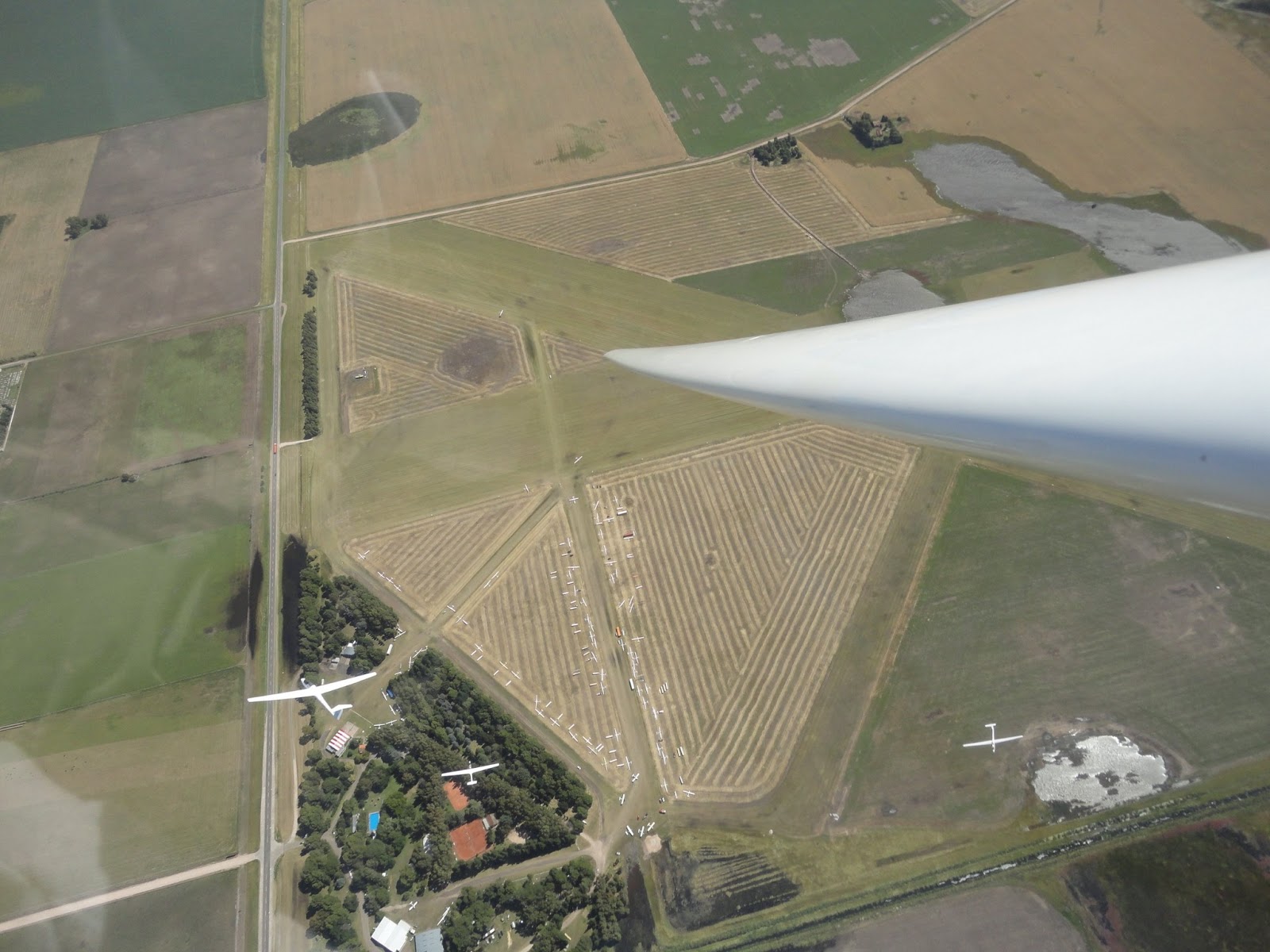
Above the A.G.Chaves airfield

After landing and tying down the glider together with Luis, I uploaded my flight (just for fun) and tried to connect to the Internet, but without any luck. So, off to the Hotel Paris café again for a coffee, a big glass of orange juice and catching up on the Blog posts and email.

Tomorrow will be the last scheduled practice day, followed by the grand opening on January 5th and the first competition day on January 6th.

Below are a couple of links related to the championship:

The official website of the 32nd World Gliding Championships (WGC) :
http://www.wgc2012.com.ar/

The Results can best be viewed here (I’m flying in the Club Class):
http://www.soaringspot.com/wgc2012/results/

My SPOT satellite tracking page (close to real time):

http://share.findmespot.com/shared/faces/viewspots.jsp?glId=0vKPpfkLXpMUN2rpVdFKNKmsyG3p3NAeW